

The maturity model progresses from:
- Reactive and fragmented
→ Structured but inconsistent
→ Standardized and controlled
→ Integrated and measurable
→ Optimized and strategic
Each of the three pillars — Governance, Standardization, and Compliance — evolves along that path.
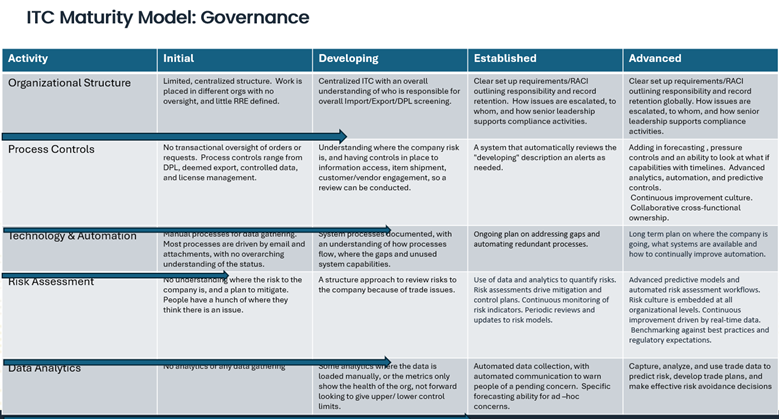
1. Governance Maturity
Governance is the foundation. It defines who owns trade compliance, how decisions are made, and how risk is escalated.
Early Stage (Far Left): Informal / Reactive
- No clearly defined compliance ownership
- Trade compliance handled “when needed”
- Leadership minimally engaged
- Policies either nonexistent or outdated
- Compliance seen as operational, not strategic
At this stage, compliance is personality-driven. If a key person leaves, the program weakens immediately.
Developing Stage: Defined but Limited
- A designated compliance lead exists
- Basic policies are documented
- Training occurs periodically
- Leadership is aware of risk but not actively involved
- Escalation pathways exist but are informal
The organization recognizes compliance risk, but governance lacks depth and structure.
Mature Stage (Far Right): Integrated and Strategic
- Executive sponsorship and visible tone from the top
- Clearly defined compliance organization with authority
- Board or senior leadership reporting
- Formal risk assessment process
- Escalation protocols documented and consistently applied
- Trade compliance embedded in M&A, procurement, and strategy discussions
At this level, governance is durable. It survives leadership changes and scales with growth.
Governance maturity determines whether compliance is a support function — or a strategic risk management discipline.
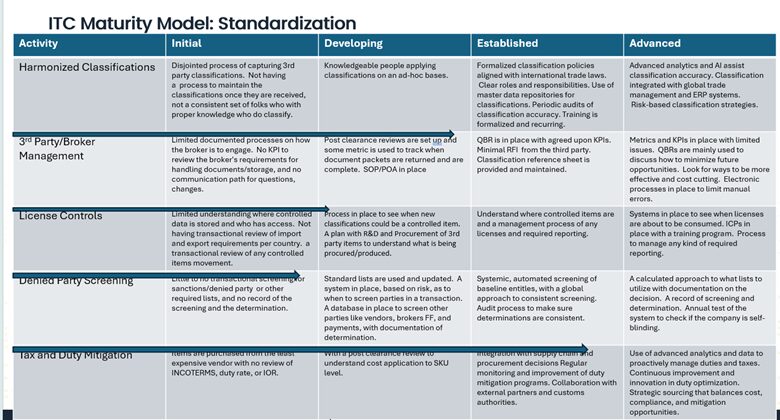
2. Standardization Maturity
Standardization addresses consistency: policies, processes, data, systems, and documentation.
Without standardization, compliance becomes subjective and inconsistent across business units.
Early Stage (Far Left): Fragmented and Manual
- Business units operate differently
- Manual screening or inconsistent tools
- Classification decisions vary by region
- No centralized documentation repository
- Data entered inconsistently across systems
This stage creates variability and audit exposure. Outcomes depend on who handled the transaction.
Developing Stage: Documented but Not Unified
- Standard procedures exist but may not be globally aligned
- Screening tools implemented but not fully integrated
- Some system controls in place
- Documentation retained but not centralized
- Data governance improving
The company has structure, but processes may still vary by geography or function.
Mature Stage (Far Right): Controlled and Integrated
- Global standardized policies and procedures
- Integrated screening, licensing, and ERP systems
- Master data governance with controlled access
- Clear version control and documentation standards
- Consistent classification methodologies
- Automated controls and audit trails
At this stage:
- Controls are systemic, not personality-based
- Exceptions require escalation
- Processes are replicable across regions
- Data integrity is monitored and measured
Standardization maturity reduces variability — and variability is where compliance risk hides.
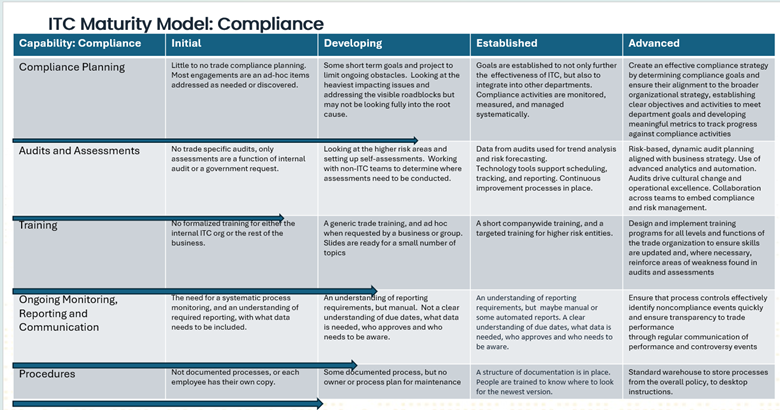
3. Compliance Maturity
Compliance maturity measures how effectively the organization identifies, mitigates, monitors, and improves trade risk.
This is where metrics, KPIs, audits, and continuous improvement come into play.
Early Stage (Far Left): Reactive Compliance
- Compliance triggered by issues or audits
- Limited KPI tracking
- Violations discovered externally
- Minimal internal testing
- Training focused on awareness only
The organization responds to problems — it does not anticipate them.
Risk visibility is low.
Developing Stage: Measured and Managed
- Defined KPIs for screening, licensing, classification
- Periodic internal audits
- Corrective action tracking
- Targeted training for high-risk roles
- Risk assessments performed intermittently
The organization begins managing compliance intentionally.
But improvement may still be event-driven rather than continuous.
Mature Stage (Far Right): Predictive and Optimized
- Risk-based monitoring program
- Trend analysis with upper and lower control limits
- Automated alerts for abnormal activity
- Continuous internal testing
- Executive dashboards tied to risk movement
- Integration of compliance into strategic planning
At this level:
- KPIs measure risk movement, not just activity
- Audit findings drive systemic improvements
- Data is used to predict exposure
- Compliance influences business decisions
Compliance maturity is the difference between “we passed the audit” and “we reduced risk.”
How the Three Sections Work Together
The model is not linear within a single pillar — all three areas must mature together.
You cannot:
- Have advanced compliance metrics without standardized data.
- Have standardized systems without governance authority.
- Have governance structure without measurable compliance outcomes.
The farther right you move across all three pillars, the more your program becomes:
- Predictable
- Scalable
- Measurable
- Defensible
- Strategically aligned
What a Fully Mature ITC Program Looks Like
A far-right maturity program demonstrates:
Governance
- Executive engagement
- Clear accountability
- Documented risk framework
- Strong escalation pathways
Standardization
- Integrated systems
- Controlled master data
- Global process consistency
- Documented methodologies
Compliance
- Risk-based KPIs
- Continuous monitoring
- Data-driven decision making
- Proactive issue detection
At this stage, trade compliance is no longer just about avoiding penalties.
It becomes a business enabler — reducing disruption, protecting reputation, and improving operational certainty.
The Practical Takeaway
Maturity is not about perfection. It is about progression.
Most organizations fall somewhere in the middle — structured but inconsistent, measured but not predictive.
The key questions to ask:
- Is compliance dependent on key individuals? (Governance gap)
- Are processes consistent across regions? (Standardization gap)
- Are KPIs measuring activity or risk movement? (Compliance gap)
The farther right you move:
- The fewer surprises you face
- The less dependent you are on personalities
- The stronger your position in front of regulators
- The more confidence leadership has in the program
A mature ITC program is not reactive.
It is resilient.
And resilience is what regulators — and boards — ultimately want to see.
Model:
Leave a Reply